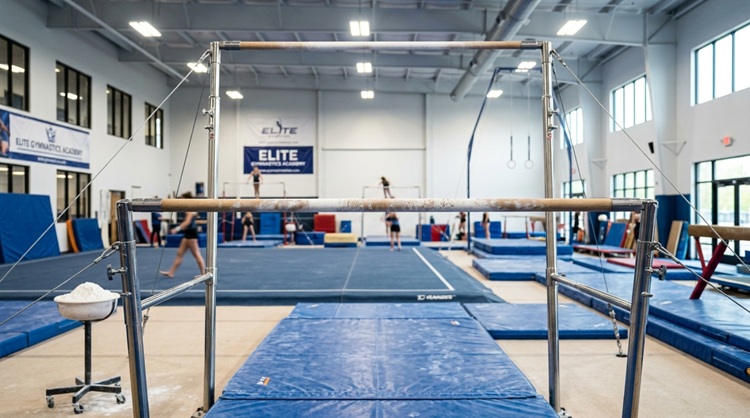
A well-planned training space shows athletes what comes next. Beginners see low, stable stations where they can learn basic shapes. Developing gymnasts find room to repeat links and landings. Advanced athletes reach apparatus that supports greater speed, height and complexity. The layout should make that progression clear without forcing every group into the same area.
Planning starts with the skills taught in the programme. A list of classes, age groups and likely progressions gives more useful guidance than buying a broad collection of products. Coaches can then identify the physical qualities behind each stage, such as balance, body tension, landing control, swing, strength and spatial awareness. Equipment choices should support those qualities as well as named skills. This prevents a shopping list from replacing a genuine teaching plan.
The first layer is confidence. Low beams, floor lines, soft shapes and stable blocks allow beginners to explore positions close to the ground. Stations need enough space for instruction and safe exits. They should also offer simple changes in difficulty, such as a wider or narrower surface, so a coach can adjust the task without rebuilding the whole hall.
As control improves, gymnastics equipment should help athletes repeat parts of a movement before attempting the complete skill. A raised surface may support take-off practice, while a shaped module can guide body position. Landing areas should match the expected movement and give the coach room to observe. Each item needs a clear teaching purpose rather than serving as decoration between sessions.
Progression does not always mean making apparatus higher. It may involve reducing support, linking two actions, increasing consistency or performing under a different entry. A flexible space therefore benefits from equipment that creates several sensible variations. However, frequent rearrangement must not produce rushed setup, unstable stacks or unclear boundaries.
Zones help coaches manage several ability levels together. A foundation group might work on shapes and rolling in one section while another group practises approach runs or bar drills elsewhere. Noise, crossing routes and waiting lines should be considered. Athletes moving between stations need a predictable path that does not pass through landing areas.
Storage belongs in the original design. Gymnastics equipment that is difficult to move or store safely often ends up in unsuitable places. Trolleys, wall racks and marked storage bays should fit the size and weight of the items. Staff also need enough time and space to return equipment without dragging it across covers or blocking exits.
Inspection routines protect the learning pathway. Before use, coaches should check surfaces, fastenings, frames, padding and stability. Wear may appear gradually, especially on frequently used beginner stations. A simple reporting process helps prevent damaged items from remaining in circulation because everyone assumes someone else has already noticed.
The room should support coaching as well as movement. Sightlines matter when one coach supervises several stations. Instructions are easier when athletes can gather without standing on active apparatus. Lighting should make edges and landing zones clear, and controls for music or timing should not pull attention away from the floor.
Future growth deserves space in the plan. A programme may add classes, extend age ranges or introduce a new discipline. Leaving some adaptable floor area is often more useful than filling every metre immediately. New purchases should connect with existing progressions rather than duplicate an item that already performs the same job.
No layout stays perfect forever. Coaches should review which stations create queues, which pieces rarely leave storage and where athletes struggle to move between tasks. Those observations turn daily use into evidence for later changes. Feedback from athletes may also reveal confusing routes or stations that feel harder to enter than expected.
A training space supports progression when each stage feels achievable and purposeful. Clear zones, suitable challenge, safe storage and regular inspection form the structure around the coaching. Chosen with that pathway in mind, gymnastics equipment becomes part of a learning system rather than a collection of separate objects.